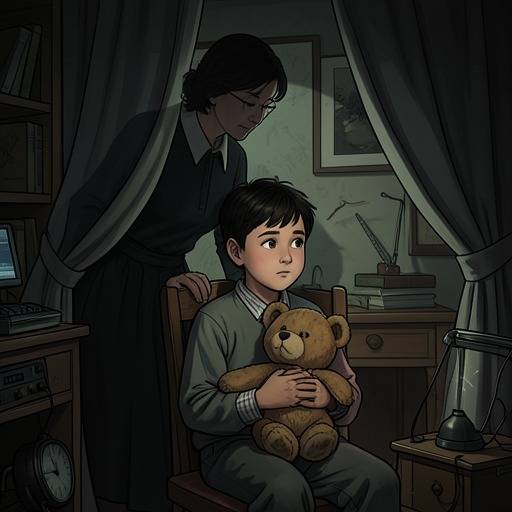
Sickness as a Friend
The RoomSickness as a Friend is the unnamed protagonist’s way of making persistent nausea into a companion, one that both torments and steadies him. The image turns an involuntary bodily sensation into a relationship: sickness is intimate, dependable, and always present, unlike the uncertain world beyond him. By the closing scene, that bond has become a refuge so compelling that he remains with it even when the prison door opens and he is called to court.
Bodily Presence and Familiarity
The motif begins in physical sensation. Nausea tugs at the back of the protagonist’s throat; he swallows automatically, and the repeated swallowing seems to spread the sickness through his body, until it inhabits every cell and breath. This is not an abstract illness described from a distance. Its location and rhythm are immediate: the throat pulls, the body responds, and the sensation becomes difficult to distinguish from the self.
The account distinguishes this persistent state from an acute vomiting episode. The protagonist knows that the nausea is not about to make him throw up now, though he anticipates that at another time he may again hang over the commode, gripping its edges as dry heaves jerk his body. That distinction matters to the comfort the sickness provides. Its presence remains unpleasant, but in this moment it is not escalating into an attack. It is familiar enough to be endured, and its constancy makes it seem more predictable than anything outside him.
The illness therefore occupies two positions at once: it is a source of discomfort and a reliable presence. The protagonist imagines that it will never desert him, wherever he goes or whatever the world does to him. The comparison to the northern star gives the sickness an almost fixed point of orientation. The reassurance does not come from recovery or relief; it comes from the certainty that the sensation will remain.
The Companion and Its Emotional Work
Calling sickness a friend gives the protagonist a way to inhabit loneliness. He imagines curling around its little ball and sharing pain associated with isolation, broken dreams, and tears on saddened faces. He also recognizes that some of those tears may have been caused by him. The imagined companionship thus does not erase responsibility: he is aware of having contributed to other people’s grief, and he measures his own pain against theirs, feeling that it ought to be less than the pain those tears represent.
The sickness offers companionship without requiring another person to answer him. Its intimacy is bodily and inward: it is already in him, moves through him, and can be relied upon without being sought out. This security is sharply limited, however. The friendship does not reconcile him with anyone or repair the damage associated with the tears. Instead, it gives him a way to bear the knowledge of them while remaining enclosed within his own distress.
The passage’s comfort is consequently uneasy rather than restorative. The protagonist can find reassurance in a condition that remains constant precisely because it does not change or make demands. His friend accompanies his loneliness, but it also holds him close to it. The image makes relief and confinement difficult to separate: what soothes him is the same bodily presence from which he cannot escape.
Drifting and Return
As the protagonist prepares to lie beneath a coarse blanket, the sickness remains a point of inward attention. The blanket’s roughness becomes soothing, and his awareness moves across the corner of the cell and the cracks where wall meets floor before his eyes close. He experiences the beginning of a familiar drifting sensation, as though he could move away from where he is, yet expects the friend to keep him from straying too far. The imagined journey ends not in a new place but in return to what is known.
The narrative describes that return through touch and bodily position. He feels the blanket against his cheek and the mattress beneath him, draws his knees toward his chest, and clasps his hands between them. The friend’s spirit seems to flow through him and settle deep within its host. As the drifting ceases, the gray darkness becomes more comfortable and he is once again fully aware of his body and the sickness inside it. The language of travel gives his retreat a pattern: departure is tentative, while return is assured.
That pattern has changed over time. The protagonist recalls journeys that once reached farther and lasted longer, but says they have become shorter and more frightening. Where he once attempted to leave the security of his friend more often, now a step or two is enough to persuade him that the outside world is not worth the effort. He stops trying. His sense of the present has become so dominant that he can no longer remember feeling otherwise, and even the act of trying to remember seems pointless.
Entrenchment and the Closing Scene
The friend’s reassurance joins a bleak view of life as a game in which people hurt one another and must be made to pay. The protagonist’s thoughts turn toward retaliatory schemes involving photographs and the children of the people he wants to punish. This turn does not undo the comfort he takes in sickness; instead, the inward refuge and the fantasies of revenge coexist. One offers a dependable private retreat, while the other imagines ways to extend suffering outward.
Near the end, the motif returns to the body in an almost mechanical rhythm. The protagonist sits with his legs hanging over the side of the bed and swinging slowly, his hands clasped between his thighs. His friend tugs at his throat; he swallows automatically. He feels it flow through him, close his eyes with a wet ache, and remain with him after what he describes as countless unsuccessful attempts to leave it. The repeated return confirms the pattern the earlier passage develops: no matter how far he tries to go, the sickness is where he ends up.
The prison door then clangs open, and a set of clothes is thrown onto the bed as a voice calls that it is court time. The protagonist does not move. He stays with his friend, his legs continuing to swing as he ignores the open doorway. The ending makes the personification consequential rather than merely descriptive: the companion that has seemed to guarantee safety now helps explain his withdrawal from an immediate demand beyond the cell. Sickness is not presented as a cure for isolation, but as the familiar condition to which he repeatedly returns, even when the world calls him elsewhere.